
Frankie Lang · 29 September 2026
Navigating Algorithm Updates Through Community-Driven Feedback Loops for Standalone Web Projects
Understanding Algorithm Shifts in Independent Web Environments
Search engine algorithm updates occur regularly and affect how standalone web projects rank in results pages, with data from multiple tracking services showing dozens of core adjustments each year that alter visibility metrics for independent sites. Those who manage such projects often track these changes through aggregated reports released by the companies behind major search platforms, yet the precise impact on individual domains requires additional layers of observation. Researchers at various institutions have documented how smaller sites without large teams experience sharper fluctuations in traffic following these shifts, particularly when content quality signals or user engagement patterns receive heightened weighting in the updated models.
Standalone web projects, defined here as sites operated by individuals or small teams without affiliation to major corporate networks, face distinct challenges because they lack access to internal testing environments used by larger organizations. Evidence from industry analyses indicates that feedback loops built within online communities allow project operators to share real-time observations about ranking movements, thereby creating collective datasets that single entities could not compile alone. In September 2026, several community platforms reported spikes in discussion threads following a documented update cycle, with participants cross-referencing domain-level metrics to identify common patterns across unrelated projects.
Building Effective Community Feedback Mechanisms
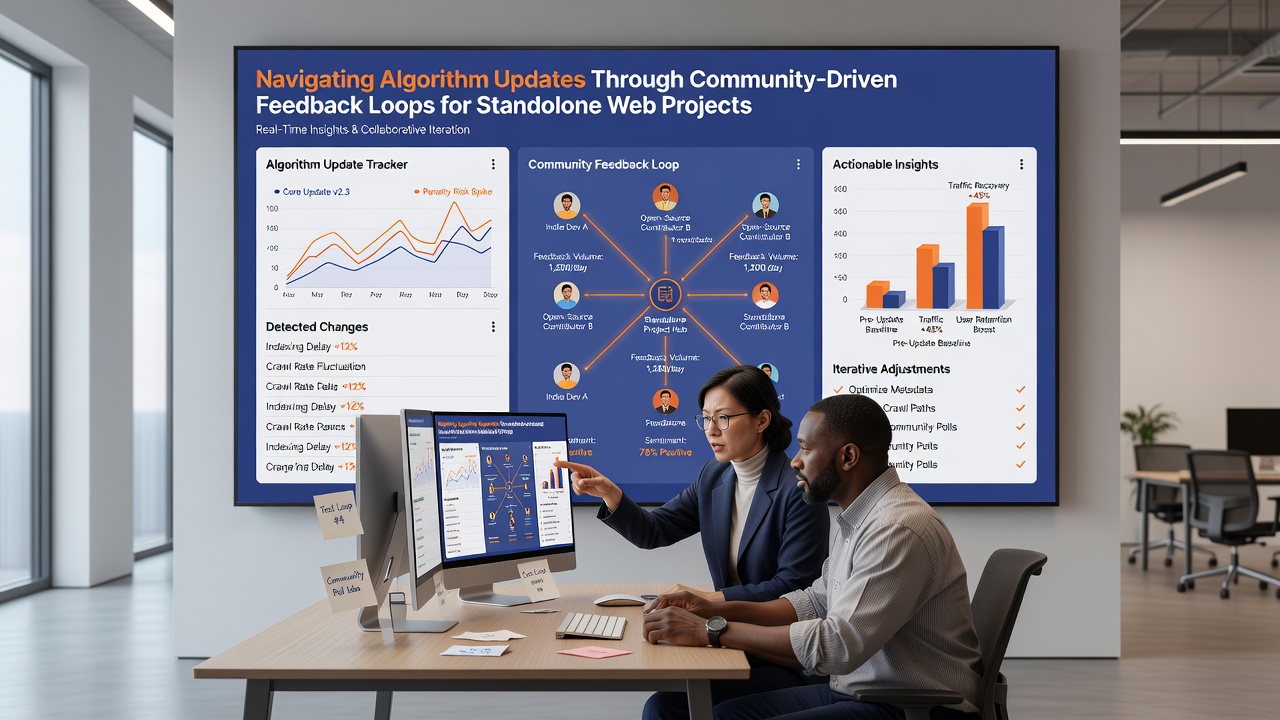
Community-driven feedback loops function through structured channels where participants post observations about traffic changes, keyword performance shifts, and content adjustments that coincide with known update dates. Moderators in established forums typically organize these contributions into categorized threads, which enables others to compare notes across different site types and geographic audiences. Data compiled from such exchanges has revealed correlations between specific on-page elements and resilience during update periods, although individual results vary based on site age, backlink profiles, and content freshness.
Operators of independent projects participate by submitting anonymized analytics summaries and receiving aggregated insights in return, a process that mirrors collaborative research models used in academic settings. One documented example involved a network of educational resource sites that pooled data after an update in early 2025, leading to revised internal linking structures that stabilized rankings for multiple members within weeks. Such exchanges rely on consistent participation and transparent methodology descriptions to maintain reliability across contributions.
Practical Applications for Standalone Projects
Implementation begins with identifying active discussion spaces that focus on technical web metrics rather than promotional content, followed by establishing verification protocols for shared data points. Participants often use standardized reporting templates that include date-stamped screenshots of search console outputs and server log excerpts, which helps filter noise from anecdotal reports. Studies conducted by research groups affiliated with European digital innovation programs have examined how these standardized formats improve the signal-to-noise ratio in community datasets, resulting in more actionable recommendations for site adjustments.
Feedback loops also extend to testing phases where community members volunteer subsets of their pages for controlled experiments, such as varying schema markup or adjusting mobile rendering priorities. Results from these micro-tests circulate through summary posts that highlight statistical trends without revealing proprietary details. Australian government reports on digital economy participation note that small-scale operators increasingly rely on such peer networks because formal consulting services remain cost-prohibitive for many independent ventures.
Challenges in Maintaining Reliable Loops
Noise from unverified claims and conflicting interpretations can dilute the value of community data, requiring active moderation and cross-validation against official statements from search providers. Those who sustain long-term participation report that establishing reputation systems, where contributors earn credibility through consistent accuracy, helps prioritize high-quality inputs. External factors such as regional differences in search result presentation further complicate direct comparisons, yet geographic diversity within communities provides broader context for interpreting localized effects.
Technical barriers including data privacy requirements and platform-specific analytics access limit some forms of sharing, although aggregated trend reporting circumvents many of these restrictions. Observers note that successful loops evolve by incorporating new tools for visualization and automated pattern detection as they become available through open-source channels.
Conclusion
Community-driven feedback loops offer standalone web projects a distributed method for interpreting algorithm updates through shared observation and verification. The approach draws on collective datasets that emerge from coordinated participation across independent operators, supported by structured reporting practices and cross-referencing methods. As search platforms continue releasing updates, including those observed around September 2026, these networks supply ongoing calibration resources that individual projects can apply without requiring enterprise-level infrastructure. Ongoing documentation from multiple regions demonstrates measurable participation growth in such collaborative systems.